Archived entries for art

Responsive Ecologies Documentation

As part of a system of numerous dynamic connections and networks, we are reactive and deterministic to a complex system of cause and effect. The consequence of our actions upon our selves, the society we live in and the broader natural world is conditioned by how we perceive our involvement. The awareness of how we have impacted on a situation is often realised and processed subconsciously, the extent and scope of these actions can be far beyond our knowledge, our consideration, and importantly beyond our sensory reception. With this in mind, how can we associate our actions, many of which may be overlooked as customary, with for instance, the honey bee depopulation syndrome or the declining numbers of Siberian Tigers.

Responsive Ecologies is part of an ongoing collaboration with ZSL London Zoo and Musion Academy. Collectively we have been exploring innovative means of public engagement, to generate an awareness and understanding of nature and the effects of climate change. All of the contained footage has come from filming sessions within the Zoological Society; this coincidentally has raised some interesting questions on the spectacle of captivity, a issue which we have tried to reflect upon in the construction and presentation of this installation. The nature of interaction within Responsive Ecologies means that a visitor to the space can not simply view the installation but must become a part of its environment. When attempting to perceive the content within the space the visitor reshapes the installation. Everybody has a degree of impact whether directed or incidental, and when interacting as a group it is interesting to see how collective behaviour can develop and incite the outcome of the work.

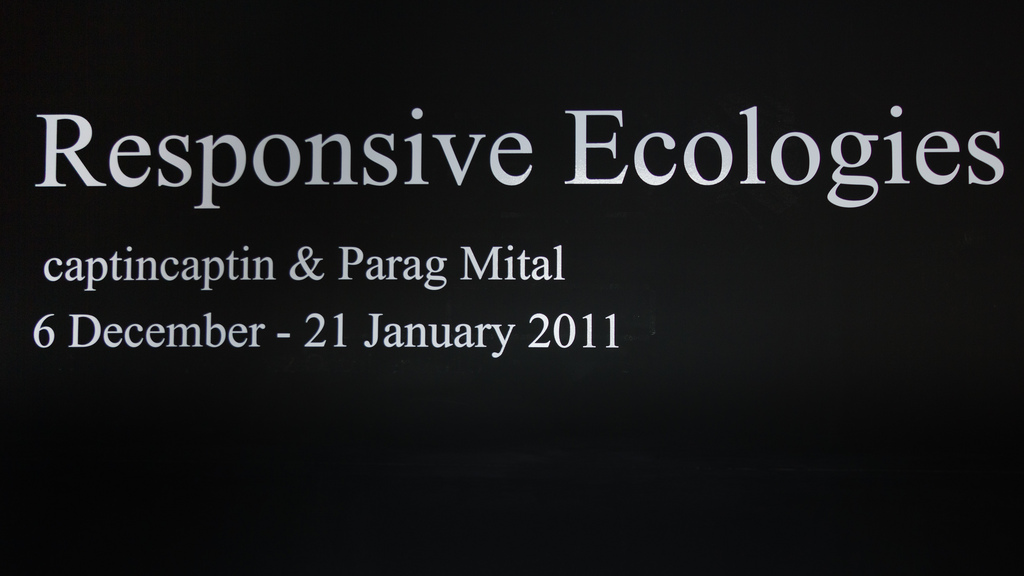
captincaptin and Parag K Mital exhibited Responsive Ecologies at the Watermans between 6th December 2010 and the 21st January 2011. The installation was in the form of a 360 degrees multi-screened projection or CAVE (Cave Automatic Virtual Environment). Visitors to the exhibition would enter the CAVE through a passageway leading from the gallery entrance. All four sides of the CAVE were back projected with each side connecting to form a large continuous projection. The presence of people within the space would be tracked and used to deconstruct and interlace the video in response to their movement. The video documentation below was taken from the installation (throughout this video the camera is panning around the space in order to record all sides of the CAVE).

Responsive Ecologies from pkmital on Vimeo.

Source code is also available with an example part of the actual installation (10 second clip as the whole video is far too long) – though you may also need 4 monitors/projectors or scale down the size of the screen in the code (SCREEN_WIDTH and SCREEN_HEIGHT variables in testApp.h): http://github.com/pkmital/Responsive-Ecologies


More information:
http://captincaptin.co.uk
http://pkmital.com

[...]

Responsive Ecologies Exhibition

Come checkout the Waterman’s Art Centre from the 6th of December until the 21st of January for an immersive and interactive visual experience entitled “Responsive Ecologies” developed in collaboration with artists captincaptin. We will also be giving a talk on the 10th of December from 7 p.m. – 9 p.m. during CINE: 3D Imaging in Art at the Watermans Center.

Responsive Ecologies is part of a wider ongoing collaboration between artists captincaptin, the ZSL London Zoo and Musion Academy. Collectively they have been exploring innovative means of public engagement, to generate an awareness and understanding of nature and the effects of climate change. All of the contained footage has come from filming sessions within the Zoological Society; this coincidentally has raised some interesting questions on the spectacle of captivity, a issue which we have tried to reflect upon in the construction and presentation of this installation. The nature of interaction within Responsive Ecologies means that a visitor to the space cannot simply view the installation but must become a part of its environment. When attempting to perceive the content within the space the visitor reshapes the installation. Everybody has a degree of impact whether directed or incidental, and when interacting as a group it is interesting to see how collective behaviour can develop and incite the outcome of the work.

The installation will encompass participants in 360 degrees with a small door opening. Some pictures of a mock setup using 2 projectors:

And a short video:

Responsive Ecologies Test from pkmital on Vimeo.

Using overhead motion capture and 4 channels of video projection, users are invited to interact in an immersive cinematic environment. The video above shows a demo proof-of-concept for the upcoming installation in Waterman’s Art Centre, London, UK, where artists captincaptin and Parag K Mital have been collaborating to install their piece, “Responsive Ecologies” for their residency the next two months. The work occurs as part of a larger on-going collaboration with ZSL London Zoo and the Musion Academy.

Earlier I posted a video showing how the motion detection works:

Overhead Blob Detection from pkmital on Vimeo.

Using OpenCV with openFrameworks to do blob detection for an upcoming installation entitled “Responsive Ecologies” at the Waterman’s Art Centre in London, UK in collaboration with artists captincaptin.

Full exhibition text follows:

As part of a system of numerous dynamic connections and networks, we are reactive and deterministic to a complex system of cause and effect. The consequence of our actions upon our selves, the society we live in and the broader natural world is conditioned by how we perceive our involvement. The awareness of how we have impacted on a situation is often realised and processed subconsciously, the extent and scope of these actions can be far beyond our knowledge, our consideration, and importantly beyond our sensory perception. With this in mind, how can we associate our actions, many of which may be overlooked as customary, with for instance, the honey bee depopulation syndrome or the declining numbers of Siberian Tigers?

The expanding distance between our lives and the natural world has created a detachment in which we begin to lose the emotion of responsibility. The exhibition references this human-nature dislocation, creating a dynamic environment which can be effeced and controlled by the audience. It aims to symbolise an embodiment of ecology, exploring the relations of organisms, and their interactions with the environment.

Responsive Ecologies is part of an ongoing collaboration with ZSL London Zoo and Musion Academy. Collectively we have been exploring innovative means of public engagement, to generate an awareness and understanding of nature and the effects of climate change. All of the contained footage has come from filming sessions within the Zoological Society; this coincidentally has raised some interesting questions on the spectacle of captivity, a issue which we have tried to reflect upon in the construction and presentation of this installation. The nature of interaction within Responsive Ecologies means that a visitor to the space can not simply view the installation but must become a part of its environment. When attempting to perceive the content within the space the visitor reshapes the installation. Everybody has a degree of impact whether directed or incidental, and when interacting as a group it is interesting to see how collective behaviour can develop and incite the outcome of the work.

Gareth Goodison and Jonathan Munro have been working collaboratively as captincaptin since 2007, creating installations and sculptures, which interact and respond to public presence, to question the role of audience participation in the display and creation of contemporary art. They have presented their work at various new media events including Future Everything Festival, Abandon Normal Devices, Leeds Expo, and the V&A. Parag K Mital is a computational visual artist and PhD student at Goldsmiths Computing Dept. investigating questions of liminality, perception, and attention in mixed reality environments.

The exhibition continues outside the theatre, presenting more outcomes of this collaboration, including the work by artists Madi Boyd and Kira Zhigalina. Special thanks to ZSL London Zoo and Musion Academy.

http://www.watermans.org.uk/exhibitions/exhibitions/future-exhibitions/responsive-ecologies.aspx

[...]

Memory and ChaoDependant at the Athens Video Art Festival 2010

DSC_0569.jpg May 7-9 saw the 2010 Athens Video Art Festival where with collaborator Agelos Papadakis, Memory saw its latest installation. The venue, a 2,500 square meters disused gas factory called Technopolis, or more commonly referred to as Gazi (Gas), was a brilliant display of warehouse spaces littered by gas pipesDSC_0063.jpg and oil still dripping from the cracks.

DSC_0180.jpg

Over 2,700 submissions were received for a total of 450 presenting artists to see over 13,000 visitors during the weekend. Among the hundreds of video art, animations, and installations, were a number of performances including dance and music.

DSC_0591.jpg

DSC_0420.jpg

Both myself and collaborator Agelos Papadakis were interviewed by ERT, or loosely translated as Hellenic Radio and Television (something like the BBC). It is all in Greek, except for my interview.

Picture 28

Video Link to the interview on EPT.

Feel free to check out pictures from the festival and my travels on my flickr page.

[...]

Neverzone, 10th June

Currently working on a video installation for an exciting gig on the 10th of June dubbed Neverzone. Check out the insanity on this flyer and information on the just as insane artists at Black Lantern Music
neverzone10jun2010_small

[...]

Video of Memory and ChaoDependant @ Kinetica Art Fair 2010, London UK

[...]

Memory at the Kinetica Art Fair 2010

I had the pleasure of exhibiting one of my works, Memory, with glass artist Agelos Papadakis at the Kinetica Art Fair 2010, from February 4-7th, 2010. The work was presented by TINTarts as well as another piece by Dave Murray-Rust, Agelos Papadakis, and Owen Green, called ChaoDependant. The fair was an incredible selection of contemporary artists and historical collections of kinetic and interactive art. I’ll be looking forward to next year.

Also worth checking out is a panorama with some interesting viewing options: www.z360.com/full/kinetica/
If you click to find the ‘Balcony’, you will see both ChaoDependant and Memory off to the side as well as Dave Murray-Rust and Agelos Papadakis in the foreground. 

As well, here is a link to our work on artstream: http://www.artstream.org/artists/view/250

I’ve also uploaded pictures on my flickr account

[...]

Add-art

TINT’s online exhibition using Add-art has gone live!

Here is what the website has to say about our piece:

Parag K Mital and Agelos Papadakis – Memory
Parag K Mital and Agelos Papadakis have worked together on a number of occasions, their piece Memory, being the most celebrated. In this piece, they explore augmented sculpture in an installation environment, allowing the audience to become an integral part of the sculpture. Creating great tension in the viewer, they have literally chained together brilliant works of glass resembling neurons to create entangling neural networks of 25 face-sized glass pieces together in a 3×3×5 meter industrial warehouse space. Within two of the glass neurons are hidden cameras tracking audience member’s faces and recording them to a computer hidden above. Using a projector and projection mapping onto each neuron, a recorded clip of one of its audience members plays as a neural network of different faces occasionally firing with a mesmerizing display. Through the disarrayed glass, ones face morphs ever so slightly, though those familiar with that face are able to recognize it still. However, the majority of faces may seem unknown to the audience members and serve merely as a memory of the piece representing those that have witnessed it.

And a screen cap of the website with Memory on it:

Nice thanks TINT!

Read more on how to setup Add-art

[...]


Copyright © 2010 Parag K Mital. All rights reserved. Made with Wordpress. RSS