Archived entries for synthesis

YouTube’s “Copyright School”

Ever wonder what happens when you’ve been accused of violating copyright multiple times on YouTube? First, you get a redirect to YouTube’s “Copyright School” whenever you visit YouTube, forcing you to watch a cartoon of Happy Tree Friends where the main character is dressed as an actual pirate:

Second, I’m guessing, your account will be banned. Third, you cry and wonder why you ever violated copyright in the first place.

In my case, I’ve disputed every one of the 4 copyright violation notices that I’ve received under grounds of Fair Use and Fair Dealing. Here’s what happens when you file a dispute using YouTube’s online form (click for high-res):


3 of the 4 have been dropped after I’ve filed disputes, though I’m still waiting to hear about the response to the above dispute. Read the dispute letter to Sony ATV and UPMG Publishers in full here.

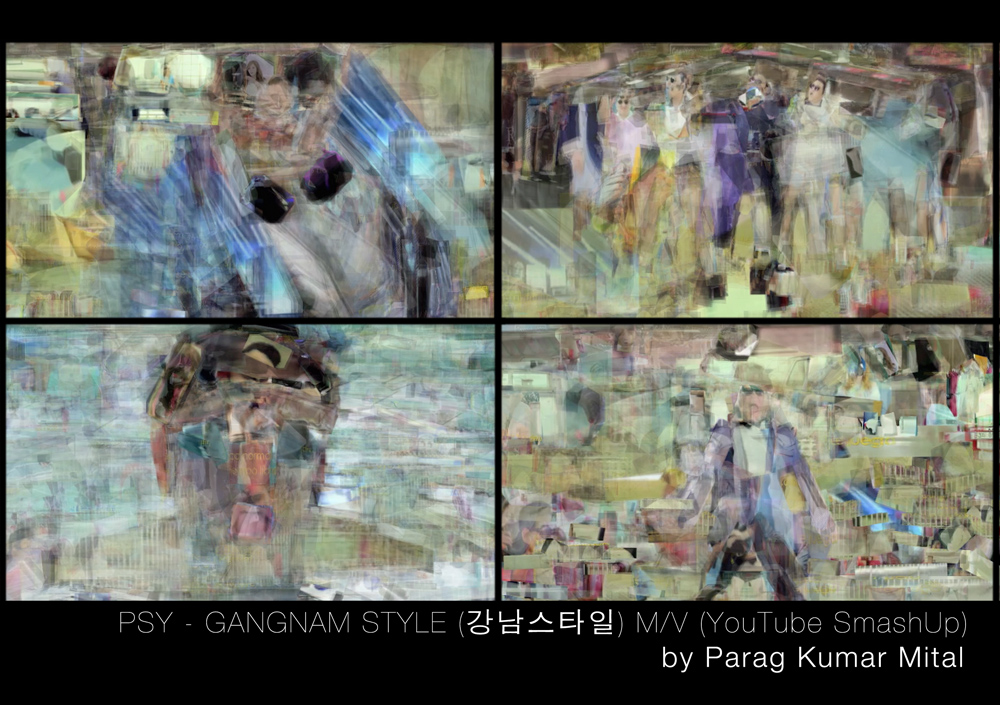
The picture above shows a few stills from what my Smash Ups look like. The process described in greater detail on createdigitalmotion.com is part of my ongoing research into how existing content can be transformed into artistic styles reminiscent of analytic cubist, figurative, and futurist paintings. The process to create the videos uses content-based information retrieval techniques that I would assume are very similar (though likely not as advanced) as the techniques used to flag the video as a duplicate copy in the first place, YouTube’s Content ID System. Until Sony and UPMG respond, the infringing video is still available on YouTube:

Regardless of my disputes, I’m now redirected to YouTube’s Copyright School whenever I visit YouTube (until I successfully complete the test):

A bit about Happy Tree Friends – it is, according to Wikipedia, “extremely violent, with almost every episode featuring blood, pain, and gruesome deaths…depicting bloodshed and dismemberment in a vivid manner.” Nevermind. I’m a copyright violater, I can handle a little dismemberment. In fact, that is exactly what I’ve done to the “Copyright School” video, dismember it with the content of 70 videos of Happy Tree Friends using the same process which brought me to YouTube’s “Copyright School” in the first place:

I hope Russell the Pirate doesn’t feel his copyright is being violated.

Related: Copyright Violation Notice from “Rightster”, Intention in Copyright, EFF Wins Renewal of Smartphone Jailbreaking Rights Plus New Legal Protections for Video Remixing, An open letter to Sony ATV and UMPG

[...]

An open letter to Sony ATV and UMPG

Dear Sony ATV Publishing, UMPG Publishing, and other concerned parties,

I ask you to please withdraw your copyright violation notice on my video, “PSY – GANGNAM STYLE (?????) M/V (YouTube SmashUp)” as I believe my use of any copyrighted material is protected under Fair Use or Fair Dealing. This video was created by an automated process as part of an art project developed during my PhD at Goldsmiths, University of London: http://pkmital.com/home/projects/visual-smash-up/ and http://pkmital.com/home/projects/youtube-smash-up/

The process which creates the audio and video is entirely automated meaning the accused video is created by an algorithm. This algorithm begins by first creating a large database of tiny fragments of audio and video (less than 1 second of audio per fragment) using 9 videos from YouTube’s top 10 list. From this database, the tiny fragments of video and audio are stored as unrelated pieces of information and described only by a short series of 10-15 numbers. These numbers represent low-level features describing the texture and shape of the fragment of audio or video. These tiny fragments are then matched to the tiny fragments of audio and video detected within the target for resynthesis, in this case the number one YouTube video at the time, “PSY – GANGNAM STYLE (?????) M/V”.

To reiterate, the content from the target video, “PSY – GANGNAM STYLE (?????) M/V”, is not used in the resulting synthesis. That is, the process is creating a new video by not merely copying the target video, but attempting to re-create it out of entirely different material, the remaining 9 top 10 YouTube videos. Abstractly, there may appear to be a similar form or structure due to the collection of many fragments organized in a similar way as the target for resynthesis. These fragments however are from a very large collection of very different material to the original content’s own material. The content used in the resynthesis itself is only from the large database of tiny fragments of audio and video segmented from 9 other videos. As a result, I would argue the use of any content within this video is only through Fair Use or Fair Dealing of the content.

This art project’s purpose is towards highlighting an important aspect of how computers and humans perceive and how copyright itself may be dealt with within a computational arts practice which by its nature has to make use of existing content. The nature of this work further seeks to transform existing material into something entirely different such that experiencing a resynthesized video reveals a new understanding of one’s own perception. The amount of the content used is fragmented in nature and assembled using a coarse idea of audiovisual scene understanding with no notion of semantics. As a result, the video itself is very abstract and at times incomprehensible. Further, its effect on the publisher’s marker as noted by the very low view rate on YouTube is marginal at best. I therefore ask you to please withdraw your copyright claim.

Sincerely,
Parag K. Mital

Related: Copyright Violation Notice from “Rightster”, Intention in Copyright, EFF Wins Renewal of Smartphone Jailbreaking Rights Plus New Legal Protections for Video Remixing, YouTube’s Copyright School

[UPDATE Dec 8, 2012: All copyright violation notices have been dropped and the video is publicly accessible.]

[...]

Memory Mosaicing

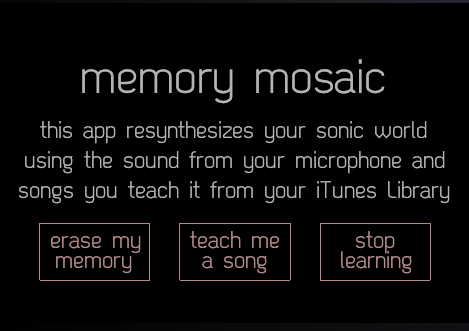
A product of my PhD research is now available on the iPhone App Store (for a small cost!): View in App Store.

This application is motivated by my interests in experiencing an Augmented Perception and of course very much inspired by some of the work here at Goldsmiths. The application of existing approaches in soundspotting/mosaicing to a real-time stream and situated in the real-world allows one to play with their own sonic memories, and certainly requires an open ear for new experiences. Succinctly, the app records segments of sounds in real-time using it’s own listening model, as you walk around in different environment (or sit at your desk). These segments are constantly built up the longer the app is left running to form a database (working memory model) for which to understand new sounds. Incoming sounds are then matched to this database and the closest matching sound is played instead. What you get is a polyphony of sound memories triggered by the incoming feed of audio, and an app which sounds more like your environment the longer it is left to run. A sort of gimmicky feature of this app is the ability to learn a song from your iTunes Library. What this lets you do is experience your sonic world as your favorite hip-hop song or whatever you listen to.

Hope you have a chance to try it out and please forward to anyone of interest.

[...]

Concatenative Video Synthesis (or Video Mosaicing)

prototype

Working closely with my adviser Mick Grierson, I have developed a way to resynthesize existing videos using material from another set of videos. This process starts by learning a database of objects that appear in the set of videos to synthesize from. The target video to resynthesize is then broken into objects in a similar manner, but also matched to objects in the database. What you get is a resynthesis of the video that appears as beautiful disorder. Here are two examples, the first using Family Guy to resynthesize The Simpsons. And the second using Jan Svankmajer’s Food to resynthesize Jan Svankmajer’s Dimensions of Dialogue.

[...]

Lunch Bites @ CULTURE Lab, Newcastle University

I was recently invited to the CULTURE lab at Newcastle University by director, Atau Tanaka. I would say it has the resources and creative power of 5 departments all housed in one spacious building. In the 12-some studios housed over 3 floors, over the course of 2 short days, I found people building multitouch tables, controlling synthesizers with the touch of fabric, and researching augmented spatial sonic realities. There is a full suite of workshop tools including a laser cutter, multiple multi-channel sound studios, full stage/theater with stage lighting and multiple projection, radio lab, and tons of light and interesting places to sit and do whatever you feel like doing. The other thing I found really interesting is there are no “offices”. Instead, the staff are dispersed amongst the students in the twelve-some studios, picking a new desk perhaps whenever they need a change of scenery? If you are ever in the area, it is certainly worth a visit, and I’m sure the people there will be very open to tell you what they are up to.

I also had the pleasure to give a talk on my PhD research in Resynthesizing Audiovisual Perception with Augmented Reality at the Lunch BITES seminar series. Slides are below, though the embedded media is removed. Comments are welcome!

Download (PDF, 1.12MB)

[...]


Copyright © 2010 Parag K Mital. All rights reserved. Made with Wordpress. RSS